Warren Buffett has shared exactly how the money his family inherits should be invested: 90% in a low-cost S&P 500 index fund and 10% in short-term government bonds.
It’s simple, inexpensive, and recommended by the greatest investor of all time.
And if you’ve owned the S&P 500, your company’s stock, or a single big winner for decades, it may be a big reason you’re able to retire.
But once your portfolio has to provide a paycheck, that concentration can carry risks it didn’t before.
In this episode, I’m sharing how to decide whether what got you here still fits the retirement ahead.
Here’s what you’ll learn:
- Why the same portfolio can look very different once you start taking withdrawals
- What you may give up by spreading your money around (and why it can still make sense)
- A simple 5-step process for reducing a concentrated position while keeping taxes in check
If you were building your portfolio today, knowing what you need your money to do, would you choose the same mix?
Listen To This Episode On:
When You’re Ready, Here Are 3 Ways I Can Help You:
- Schedule a Free Retirement Strategy Session. Get your questions answered + learn how we can help you improve retirement success and lower taxes.
- Listen to the Stay Wealthy Retirement Show. An Apple Top 50 investing podcast.
- Join My Retirement Newsletter. Weekly retirement and investing tips (delivered to our inbox!)
+ Episode Resources
- Warren Buffet 2013 Shareholder Letter
- International Stock Outperformance When U.S. Stock Returns Are Low
- The 1970’s Hypothetical Example
- The Lost Decade Hypothetical Example
- The Lost Decade 5% Withdraw Hypothetical Scenario
- Guyton Guardrails – FPA Academic Paper
- How to Invest During a Lost Decade
- 10% Average Stock Market Returns
- Additional Disclosures
—
+ Episode Transcript
It can be hard to rethink an investment strategy that’s worked well for you. Especially when it’s simple, inexpensive, and recommended by Warren Buffett.
In his 2013 shareholder letter, Buffett shared instructions for the money his wife will inherit if she outlives him: 90% in a low-cost S&P 500 index fund and 10% in short-term government bonds.
I can certainly understand the appeal of this advice, and if you’ve owned the S&P 500 for decades, or another highly concentrated investment, it may have helped put you in a position to retire.
But as you begin relying on your savings to fund retirement goals, it’s worth considering if and how that investment fits into your plan. And if you decide some changes would help, what do you do about the gains you’ve built up over time?
In today’s episode, we’ll work through that decision. We’ll look at how taking withdrawals changes the way you evaluate a portfolio, what you give up by spreading your money around, and a five-step process for making adjustments while keeping taxes in mind. My goal is to help you evaluate what you already own and decide how well it fits the retirement ahead of you.
Welcome to another episode of the Stay Wealthy Retirement Show. I’m your host, Taylor Schulte, and every week, I tackle the most important financial topics to help you stay wealthy in retirement. And now on to the episode.
Why the S&P 500 Isn’t Enough Once You Retire (And 5 Tax-Smart Steps to Diversify)
When we’re faced with too many options, we don’t feel empowered, we actually feel overwhelmed, and we revert back to something familiar. Behavioral experts call this the paradox of choice.
And that’s exactly what’s happening with retirement investing today.
You log into your account and you’re hit with 50, 100, sometimes thousands of investment options. Growth, value, small-cap, large-cap, international, bonds…mutual funds, exchange-traded funds, closed-end funds… it’s understandably exhausting.
So, as a result, most people freeze and default to the thing they recognize — or the thing that’s been performing best recently — or the thing they heard the greatest investor of all time recommend. And for most of this century, that’s been the S&P 500.
Compared to the thousands of other confusing options, it feels simple and smart and safe, but in reality, it’s actually exposing you to the very risks you’re trying to avoid — especially in retirement, when your portfolio has to consistently provide a paycheck.
What many people don’t realize is that proper diversification — and proper is the key word here — proper diversification can actually reduce risk and improve long-term returns while also being simple and low-cost. You don’t have to choose between simple and smart; you can have both.
And in a moment, I’ll walk you through the data that proves it. But first, let’s quickly discuss why investing most of your savings in the S&P 500 may be far riskier than most retirees realize.
Why S&P 500 Concentration Is Riskier Than It Seems
An S&P 500 index fund owns 500 of the largest companies in the United States.
On the surface, that sounds quite diversified, especially compared to your stock-picking neighbor. But here’s the primary problem: the S&P 500 is made up of ONLY U.S. stocks. Meanwhile, there are over 18,000 other publicly traded companies outside of America, representing 35% of the global equity market. By concentrating everything in a single country, you’re introducing a very real form of geographic risk.
Now, I know what you might be thinking. “But Taylor, the U.S. stock market has been the world’s top performer for decades; why would I bet against this country?”
And technically, you’re right. US large cap stocks have delivered higher returns with less volatility than international markets over the last fifty plus years. But here’s where that logic breaks down, especially for retirees: investment returns are lumpy.
Those attractive long-term averages you see in headlines… they don’t show up neatly every year.
In fact, since 1926, the S&P 500’s long-term average annual return has been about 10%. However, across all 10-year rolling periods over the past 100 years, it only delivered 10% or more per year roughly 50% of the time. In other words, investors should expect real-world 10-year results to swing above and below that 10% “average” far more often than they match it exactly.
Investment returns are lumpy. Sometimes US stocks skyrocket. Sometimes they collapse. And sometimes, they go nowhere. And that inconsistency creates two big problems. First, investing is highly emotional. As Charlie Ellis once said, “The average long-term experience in investing is never surprising, but the short-term experience is always surprising.”
And when your portfolio constantly surprises you, it becomes much easier to panic and make costly decisions. For retirees, those surprises aren’t just stressful, they’re incredibly dangerous. Panic selling and stuffing everything under the mattress or ditching a strategy to chase the next popular investment trend, can quickly derail your entire plan.
Smart, global diversification helps smooth out that ride, and in turn, dramatically improves your odds of staying invested for the long run. And staying invested for the long run is critical in retirement for those relying on their portfolio for predictable, sustainable income.
Second, when you’re retired and taking regular withdrawals, your S&P-only portfolio lacks assets that zig when U.S. stocks zag. And that matters. A lot. Because once you’re drawing income from your portfolio, the order of your returns becomes just as important as the returns themselves.
If your U.S. stocks drop sharply while you’re in retirement and you’re forced to sell shares at a loss to fund your expenses, you could permanently reduce your future spending power. That’s what’s known as sequence-of-returns risk.
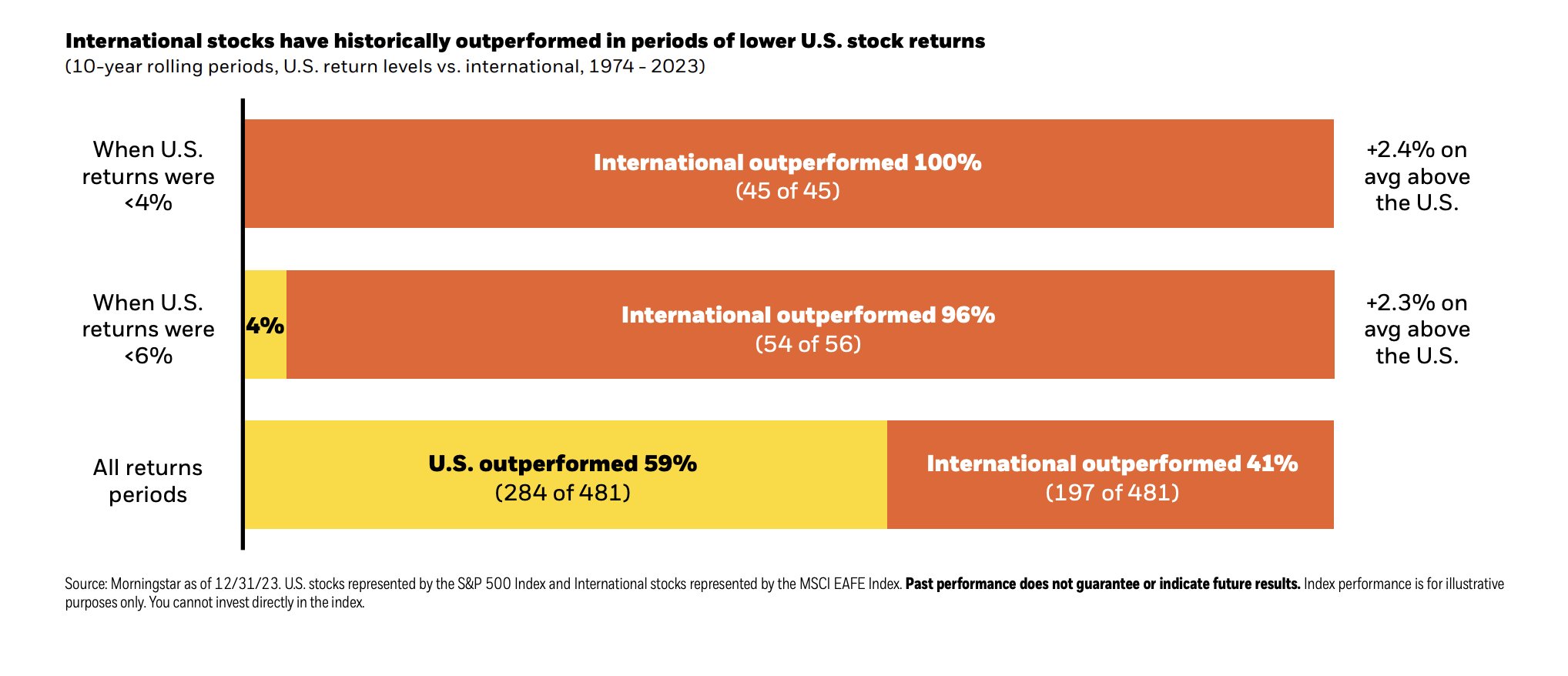
Global diversification helps buffer against that. In fact, let’s revisit one of my favorite statistics I’ve shared on the show before that highlights the benefit of global diversification for retirees: since 1974, in every single year when U.S. stock returns were below 4%, international stocks outperformed — by an average of 2.4%.
I’ll say that again so it sticks. In every single year when U.S. returns were less than 4%, international markets outperformed — not just by a little, but by an average of 2.4% per year.
That kind of diversification isn’t theoretical, it’s practical. It gives you something, or some THINGS, in your portfolio to sell when U.S. stocks are down, allowing you to fund your retirement income without locking in losses and without stress or worry.
And I’m about to show you how it’s helped retirement investors through two major storms, by showing you the exact returns of the S&P 500 versus a properly diversified global portfolio.
1970s: Inflation Storm
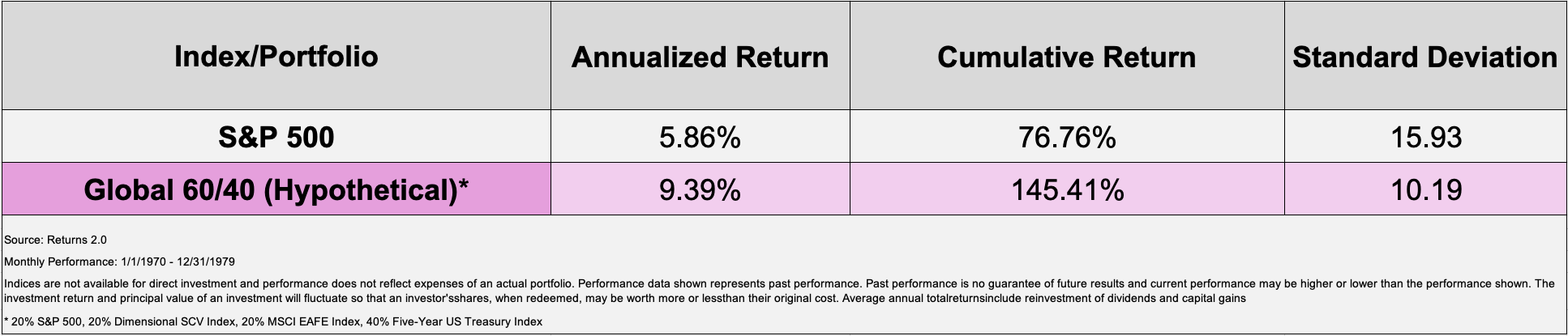
The first major storm to review took place in the 1970s. Since data and investment options were more limited then, for this comparison, our hypothetical diversified portfolio looked like this: 20% S&P 500, 20% Small Cap Value, 20% International Developed stocks, and 40% in 5-year Treasury Bonds.
So, from 1970 through the end of 1979, the S&P 500 delivered a total return of about 76%, roughly 6% per year on average. Not terrible, right? On paper, maybe. But here’s the problem: inflation averaged nearly 7% per year during that same decade. So after inflation, S&P 500-only investors actually lost purchasing power, even though they generated 6% average returns. Their so-called “growth” portfolio didn’t grow at all in real terms, after inflation was factored in.
Our hypothetical globally diversified portfolio, on the other hand, averaged about 9.5% per year during this same time period. After inflation, that means globally diversified investors not only preserved their purchasing power, they grew it. Even through one of the most difficult decades for retirees in history, diversification turned a challenging 10 year period into a survivable one.
A few decades later, the world changed — but the lesson didn’t. Diversification was still the retiree’s best shock absorber, and it was about to be tested again.
It was the early 2000s when another storm hit, one that everyone listening remembers all too well. And this time, investors had more tools at their disposal. So instead of the simple 1970s mix, our updated diversified portfolio builds on the same foundation but adds real estate, emerging markets, and international value stocks to the portfolio.
So, from 2000 to 2009, the S&P 500 lost about 9% in total. A negative 9% total return over ten full years, commonly referred to as the Lost Decade.
And it wasn’t just a slow erosion. The S&P 500 actually dropped more than fifty percent twice in those 10 years. Two devastating crashes in a single decade — that’s the kind of volatility that can cause serious stress and anxiety, and even worse, derail a retirement plan overnight.
Now, if you had mixed in some bonds — say, a basic 60% S&P 500, 40% bond portfolio — you would’ve absolutely weathered this storm better. That negative 9% loss would’ve turned into roughly a 33% total gain with a simple 60/40 allocation.
An improvement for sure, but a roughly 3% average return in the face of inflation that averaged around 2.5%, was likely not enough to give you the ability (and confidence) to maintain your desired lifestyle in retirement.
Here’s where it gets interesting. Our hypothetical global portfolio, the one with exposure to multiple evidence-based classes and geographic regions — returned well over 100% during that same period.
That’s not a rounding error. That’s the difference between barely keeping your head above water and doubling your money (i.e., your purchasing power) through one of the worst decades in market history.
And this, hopefully, helps to highlight the danger of single-country concentration. Because, when — not if, but when — the U.S. hits a rough patch, your entire portfolio suffers. But with a properly built, globally diversified portfolio, you’ve got multiple engines driving your returns. For retirees, that means a smoother ride and consistent income, even when one part of the market is struggling. And perhaps most importantly, it means dramatically lowering the risk of running out of money in retirement.
Lost Decade – Retirement Spending Example
Let me explain what I mean by sharing one of my favorite hypothetical, yet very relatable scenarios with you.
Imagine you retired in the year 2000 with a $1 million dollar portfolio. You start withdrawing $50,000 per year from your investments, adjusting your annual withdrawals for inflation — a pretty typical withdrawal scenario for a retiree who wants to enjoy retirement and doesn’t want to die with a pile of money.
If you followed this spending plan and invested your $1 million dollar nest egg in the S&P 500 — the “simple, proven” choice — your portfolio would’ve been completely drained in just 16 years.
If instead, you built a properly diversified global portfolio — one that included small-cap and value stocks, international exposure, and real estate — you would have ended that exact same period with more money than you started with. That’s the power of smart diversification in retirement.
When you’re still in your working years and accumulating money, you can more easily ride out volatility and challenging times. You can take a simpler, possibly more concentrated investment approach and you can ignore headlines, stay the course, and since time is on your side, you can patiently wait to recover from storms.
But once you start taking withdrawals from your portfolio, the game changes. Every dollar you pull from a falling asset class is a dollar that can’t recover later — which is why proper diversification becomes absolutely critical in retirement.
So, to be extra clear, what I’m sharing with you today is not about trying to outsmart the market or boosting return; it’s about protecting your paycheck, preserving your peace of mind, and giving you confidence to enjoy the retirement you worked so hard for.
When I share this data with retirees or soon-to-be retirees, it helps them see how true diversification has performed through catastrophic events, and their perspective completely shifts. They realize that “safe” isn’t necessarily about owning what’s familiar or sticking with the investment plan that got them to the finish line; it’s about building an academically sound portfolio that stays strong when the world doesn’t.
Taking Action
Still, even the strongest portfolio isn’t the full story. Because once you retire, new variables start to appear — taxes, income timing, healthcare costs, legacy goals.
Each one has the power to undo the progress your portfolio makes if it’s not coordinated. True confidence doesn’t come from investments alone; it comes from connecting every piece of your financial life so it all works together.
But even after learning and understanding this, most retirees still treat their investment strategy like it’s their entire plan. They invest in a diversified portfolio, hit “set it and forget it,” and assume they’re done.
Then reality sets in. Taxes start eating away at returns, RMDs push up Medicare premiums, and that “perfect portfolio” doesn’t feel so perfect anymore.
True retirement success doesn’t come from a single chart or even a perfectly diversified portfolio — it comes from connecting all the pieces of your financial life so they work together instead of against each other.
At my firm, we use a proven, four-step framework to connect the four big levers in retirement—Taxes, Income, Legacy, and Investments—into one single coordinated plan. The goal and intention behind building this framework is to avoid solving problems in isolation, because, in retirement, every tax decision affects your income, which affects what you can safely spend and ultimately what you leave behind. And most people, including financial professionals, want to start the discussion or planning process by addressing investments. I get it, talking about investments is often way more fun and interesting than talking about Medicare IRMAA or RMD planning. But in our framework, investment strategy is intentionally the last step. This way, by the time we get to investments, the portfolio will be backed by a tax-smart, income-aligned, legacy-aware plan. In my experience, this process and framework not only improves the odds of long-term retirement success, it also removes a lot of the emotion and guesswork and turns investing from something stressful into something strategic and repeatable.
Now, while every allocation is unique to a client’s needs and goals, at a high level, our globally diversified portfolios contain the exact asset classes I reference in the hypothetical scenarios today: REITs, emerging markets, large and small international stocks, and large and small U.S. stocks, all with an extra weighting on stocks with profitability, quality, and value characteristics. We don’t include these asset classes because they sound important, but because academic research has proven that they complement each other in a diversified retirement portfolio.
When it comes to bonds, our goal isn’t growth — it’s protection and income — so we use a mix of high-quality U.S. Treasuries and inflation-protected securities, and ditch riskier solutions like lower-grade corporate bonds.
The right mix between these major asset classes helps stabilize your income, dampen volatility, and keep your long-term plan intact when markets get noisy. It also supports the research that drives the Retirement Guardrails strategy.
For example, if you’re following the Guardrails-based withdrawal strategy, have a $1 million portfolio, and need about $55,000 per year, the research points to an allocation of 65% global stocks, 25% bonds, and 10% cash.
If you need more or less income from your portfolio, you would simply adjust your stock-bond mix up or down — you would allocate more to stocks for growth and higher withdrawals, and more to bonds for stability and lower withdrawals.
Again, to be extra clear, a portfolio like this isn’t about chasing or boosting returns — it’s about coordination and alignment with retirement goals. It balances healthy growth with downside protection, inflation defense, and tax efficiency, all within a system that works in harmony. When you properly connect all of the pieces of your financial life, you stop managing your money in isolation and start managing it like a complete, evidence-based retirement plan – one that gives you peace of mind and confidence.
Trade-Offs of Diversification
Before we wrap up, I want to round out this discussion with two things.
First, I want to touch on the long stretches when the S&P 500 outperformed a globally diversified portfolio, because we need to acknowledge the trade-offs that come with spreading your money around.
And then second, we’ll walk through a five-step process for putting changes into practice, especially if you’ve held U.S. stocks for years and have a substantial tax bill to consider.
Let’s start with those trade-offs, because much of the recent experience for investors has been very different from the difficult decades we covered earlier.
To put some numbers to it, from 2010 through 2024, the S&P 500 returned close to 14% a year, compared with about 6% for developed international stocks. That’s a substantial difference over fifteen years, and would have caused a globally diversified portfolio to trail the S&P 500 over that stretch of time.
That’s the trade-off you have to be comfortable with. When you spread your money across different asset classes, some will lag behind others, sometimes for years.
In addition to not having a crystal ball, the challenge this presents is that we have to build our retirement portfolios without knowing which investments will lead.
Someone who retired in 2010 had a very different experience owning the S&P 500 than someone who retired in 2000. And when you’re taking withdrawals, those differences can affect how much you can spend and how long your money lasts.
We also don’t have to look very far back to see a change in leadership.
In 2025, the S&P 500 had a strong year, returning nearly 18%. But developed international stocks returned about 31%, and emerging markets returned nearly 34%.
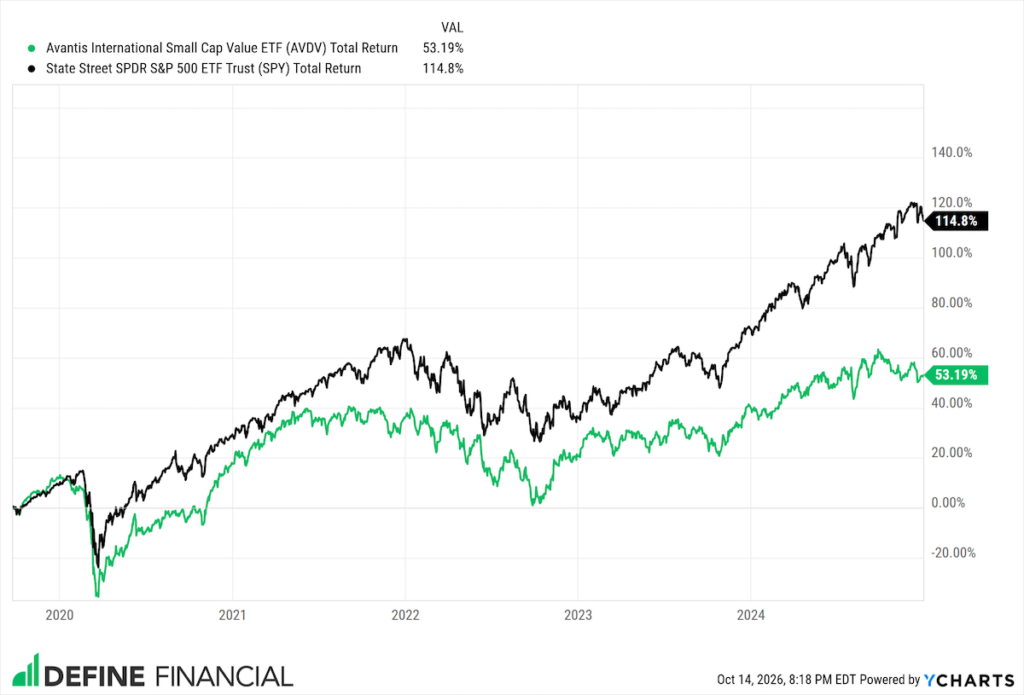
And it’s worth remembering that, just like here in the U.S., not all international stocks behave the same way. Over the last five years, international small-cap value stocks, as represented by the Avantis ETF AVDV, have actually outperformed the S&P 500 by roughly 2% per year.
Now, I’m not sharing any of this to suggest you should go chase international stocks, or buy any one fund. A strong year, or even a strong five years, doesn’t prove anything, and chasing recent winners is the same mistake, just pointed in a different direction.
I’m sharing it because no one — not me, not Wall Street, and not even the greatest investor of all time — reliably knows which part of the market will lead next. Or for how long.
So, to put it simply, diversification isn’t a bet that international stocks or any other asset class you include in your portfolio will win. It’s an admission that we don’t know who will win. And when your portfolio is funding your paycheck, being wrong in a big way at the wrong time can be very costly
The S&P 500 can and likely should absolutely have a place in a retirement portfolio. What deserves some thought is how much of it you own, alongside the other investments you’re relying on to fund your retirement goals.
Now, if that review leads you to make changes, the next consideration is how to make them tax-efficiently, because if you’ve held an investment for a long time, the tax cost of selling can make you feel stuck.
The good news is that you don’t have to sell everything at once – you can diversify gradually, over a few years, by following a simple five-step process.
Making the Switch Without a Big Tax Bill
Step one: is to decide where you’re going. Before you sell anything, set your target asset allocation mix based on your unique retirement needs and goals — how much you want in U.S. stocks, international stocks, emerging markets, bonds, and any other asset classes you believe are prudent to include. Without a clear target, it’s hard to know what to sell, how much, or when you’re done.
Step two: start with your retirement accounts. In an IRA or 401(k), you can sell highly appreciated positions you have and rebalance into more appropriate investments without triggering any tax. For many retirement savers, that’s where most of the money lives, so it’s often where most of the progress can happen in the near term.
Step three: is to put your cash flow to work. Dividends, interest, and any new savings can go toward what’s underweight instead of back into large-cap U.S. stocks or blindly spread evenly across your portfolio.
And, the opposite is true as well. When you take withdrawals from your portfolio to fund living expenses or required minimum distributions, consider taking those distributions from what you have too much of. You need to sell something anyway, so use that opportunity to choose what you sell on purpose.
Step four: use your low-tax years. For example, long-term capital gains can be taxed at 0% when your taxable income is low enough. In 2026, for a married couple filing jointly, that 0% rate applies up to $98,900 of taxable income. For many people, the years between retirement and when Social Security and RMDs begin can be a window to sell some shares at little or no tax. That same window is often valuable for Roth conversions too, so it’s worth running the numbers on both.
Step five: save your biggest gains for last. Your most appreciated shares may be better off never sold. If you have charitable giving goals, you can donate those shares instead of cash, often through a donor-advised fund, and no one pays tax on the gain. And if you expect to leave these highly appreciated investments to your heirs instead, they may receive a step-up in cost basis at your death, which can erase that built-in gain as well.
Working through these five steps can help you see which changes are straightforward, which need some tax planning, and which may not be necessary at all. For some people, much of the adjustment can happen quickly and easily inside retirement accounts. For others, spreading sales over several years will make more sense. And sometimes, sucking it up and paying a meaningful amount of tax in one year is a worthwhile decision to reduce a risk you no longer need to take or should be taking.
Bottom Line
If today’s episode prompts you to revisit your portfolio, start with a simple question: would I choose this same mix of investments today, given what I need my money to do? I think it’s worth asking, especially if your portfolio has taken shape over years of contributions and market gains without much deliberate planning or proactive adjustments. Your answer can help you decide what to keep, what to adjust, and where those five steps might be most useful.
As always, if you have any questions that you think I can answer, please send me an email at podcast@youstaywealthy.com. And if someone came to mind while you were listening today — a friend or family member with most of their savings in a single stock or asset class — this might be a good one to pass along.
Thank you, as always, for listening, and once again, to view the research and resources referenced in today’s episode, just head over to youstaywealthy.com/306.
Disclaimer
This podcast is for informational and entertainment purposes only, and should not be relied upon as a basis for investment decisions. This podcast is not engaged in rendering legal, financial, or other professional services.